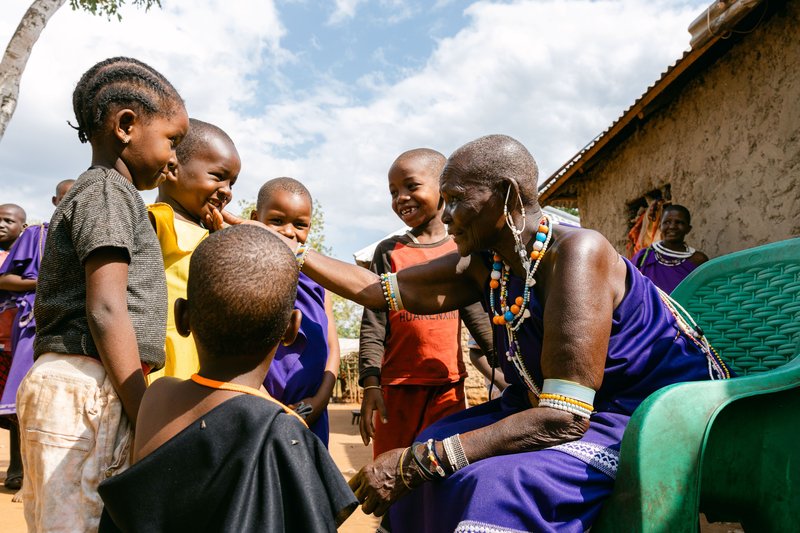
Hadija Mtitu sits on a chair surrounded by her grandchildren in Pwani, Tanzania.
Sam Vox/Uniting to Combat NTDs
Efforts to eliminate neglected tropical diseases (NTDs) are gaining momentum across the world. Political will is building, research on treatment and vaccines is intensifying, and donations of vital medicines are continuing, among other critical interventions. While this is all essential and needs to continue apace, the constant lack of both policies and resources required to safeguard the basic human rights of those affected by these diseases remains a vital missing link in the solution to eliminate these diseases and uphold the dignity of those affected.
NTDs are a group of 21 preventable and treatable diseases that affect about 1.5 billion people around the world. They can cause immeasurable suffering, debilitate, disfigure and can be fatal. By most commonly affecting some of the most vulnerable people in the world, NTDs create cycles of poverty and cost nations billions of dollars each and every year. Predominantly affecting populations with low visibility and limited voice, NTDs disproportionately impact rural communities that have limited financial resources and are a significant source of stigma and discrimination, particularly for women and girls. As such, NTDs keep communities in a cycle of poverty; sick people can't work, sick children can't learn, and this perpetuates poverty and inter-generational disadvantage.
NTDs are inextricably linked with human rights, both as a cause and a consequence of human rights violations. This is because when one right is violated, it can affect the enjoyment of all other rights. For example, a lack of access to clean water can cause health issues, such as an NTD, and impact a person's right to work. While violations of the right to health can impact the enjoyment of, and entitlement to, other human rights, such as the rights to education, to an adequate standard of living, and vice versa. And this is clearly evident in the case of NTDs. Preventing and treating NTDs is crucial to addressing violations of human rights, as well as upholding the dignity and well-being of affected individuals. Despite these critical connections, the human rights implications of NTDs have not received adequate attention.
As a result, children affected by NTDs often drop out of school, impacting future employment opportunities and their ability to earn a decent living. Households lose income when men and women are affected and cannot work or have to take on caregiving roles for affected family members. This not only perpetuates cycles of poverty but also impacts the economy through loss of tax revenues. On top of this, the economic cost of NTDs is high for affected households. The household income lost from out-of-pocket health expenditures and the wages lost due to NTDs is estimated to be at least US$33 billion dollars per year, according to the WHO Rationale for Investment in NTDs.
All of this could of course worsen considerably as the effects of climate change leads to transmission areas for vector-borne NTDs spreading to areas where they were not previously.
Protecting the rights of affected populations must become a global priority. While NTDs are captured in several global agreements, they do not address the core human rights of those living with NTDs. Under the International Covenant on Economic Social and Cultural Rights, member states have obligations to progressively realise non-discriminatory access to health services, particularly for vulnerable and marginalised groups, provide access to basic needs, offer essential drugs and educate communities on health.
Of all the 21 NTDs, leprosy remains the only one that has focused efforts on addressing the human rights dimensions of those affected by leprosy and their families, with the Human Rights Council most recently adopting a resolution in 2023 to intensify efforts to eliminate all forms of prejudice and discrimination against persons affected by leprosy and their family members. This focus on the human rights of those affected by leprosy needs to be expanded to all NTDs if we are serious in wanting to eliminate these diseases for good. This will require a comprehensive study on the human rights dimensions of NTDs to address the underlying social determinants and what is required to address NTDs once and for all.
Attention also needs to be directed at arming people affected by NTDs with the information and education required to ensure that their rights are upheld.
As such, if we are serious about addressing NTDs, then it follows that a human rights-based approach must be a core part of efforts to effectively prevent, treat and eliminate NTDs once and for all.
Protecting the rights of people affected by NTDs will only be possible if governments commit to prioritise them.